


TLDR
An asset integrity engineer makes sure pressure vessels, piping, pipelines, structures and safety-critical equipment in an oil and gas facility stay fit for service across their full lifecycle. The role is mostly office-based and standards-led, sitting between inspection, corrosion engineering, reliability engineering and operations.
This post covers what the role looks like in practice, the standards and methodologies you will work with, how it differs from a mechanical or pipeline integrity engineer, the skills operators hire for, typical 2026 salary ranges, and the fastest CPD-accredited route into the specialism.
What an asset integrity engineer actually does
If you are a mechanical or chemical engineering graduate looking at oil and gas job listings, an inspector who has spent five years on NDT and wants the design-and-decision side of the role, or a corrosion engineer asked to own the integrity programme for an ageing asset, the role you are looking at is the asset integrity engineer. The honest framing first: the work is mostly desk-based, regulatory, and compliance-driven, and that is not a complaint. That profile is exactly what makes the role steady, well paid and visibly valuable to the operator.
On a given week, an asset integrity engineer might:
- Run a Risk-Based Inspection (RBI) study under API 580 and 581: probability of failure, consequence of failure, equipment criticality, and the inspection plan that drops out the other side.
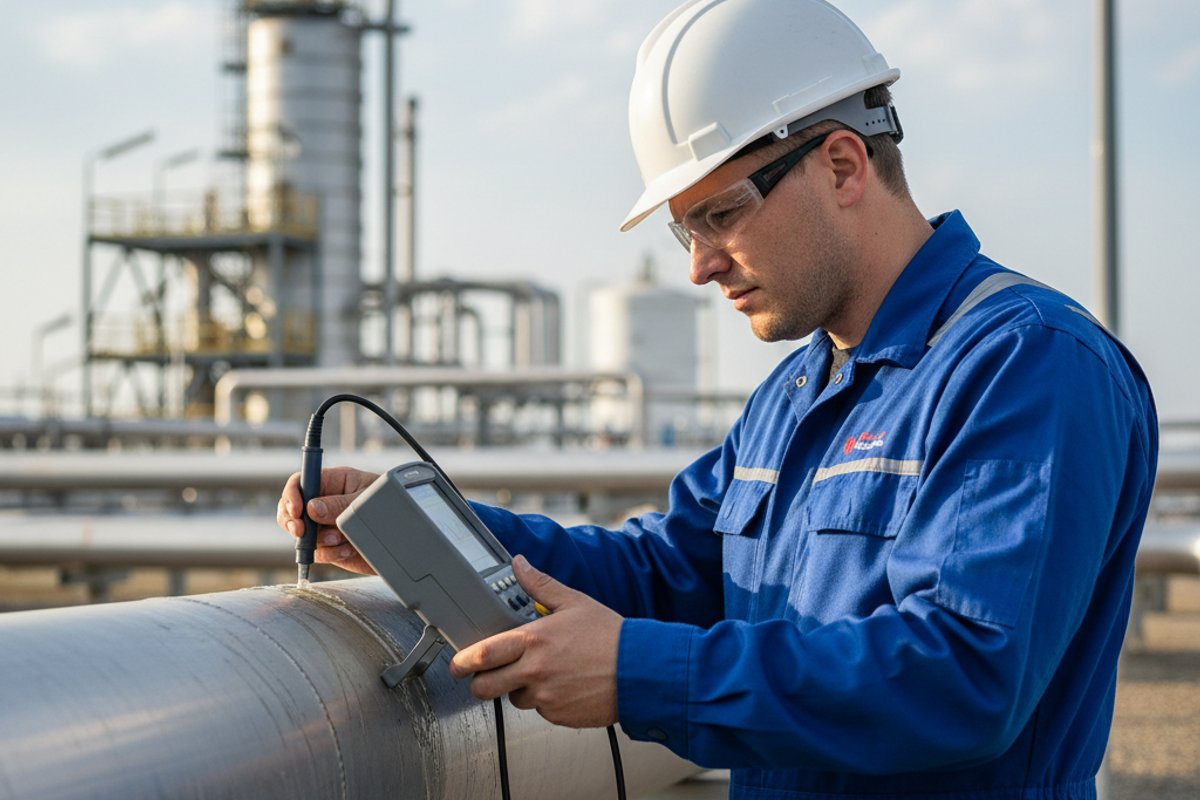
- Review NDT (non-destructive testing) reports against the inspection plan and decide whether the wall thickness, crack indication or coating condition is fit for service.
- Carry out a Fitness-for-Service assessment to API 579-1 / ASME FFS-1 on a corroded pressure vessel or pipeline section, and recommend repair, derating or replacement.
- Sit with the operations team to agree the inspection schedule, the shutdown windows, the work-pack scope and the budget impact of the next maintenance cycle.
- Walk down a process unit during a turnaround, verify the inspection findings against the field reality, and sign off on the safety-critical-element status before the unit goes back into service.
- Update the integrity management plan and the KPIs the asset reports against, and answer the regulator’s audit when it lands.
The output of the role is not a single inspection report. A good asset integrity engineer holds the picture of the asset’s risk position together over time, prioritises spend, and gives the asset manager an honest read on what the equipment can do for the next five years and what it cannot.
The standards and methodologies you will work with
Most of the technical work falls into a clear stack, and a competent asset integrity engineer can move between the parts of it with a working knowledge of each.
- Risk-Based Inspection (RBI) under API 580 and 581: the engine of the role. Qualitative, semi-quantitative and quantitative methodologies, damage-mechanism review, risk matrix construction and inspection-frequency optimisation.
- Inspection codes and standards: API 510 for pressure vessels, API 570 for piping, API 653 for atmospheric storage tanks, ASME B31.4 and B31.8 for pipelines, ASME Section VIII for pressure-vessel construction. The inspection plan you write lives or dies by these.
- Corrosion and damage mechanisms: general and pitting corrosion, microbiologically influenced corrosion (MIC), stress corrosion cracking (SCC), hydrogen-induced cracking (HIC), creep, fatigue, erosion. NACE and DNV standards on materials selection and cathodic protection sit alongside the inspection codes.
- Fitness-for-Service (FFS) assessment under API 579-1 / ASME FFS-1: deciding whether equipment with corrosion, cracking or pitting can stay in service, and on what conditions.
- Asset management framework under ISO 55000 and the operator’s own integrity management system. The framework that ties inspection, maintenance, repair and replacement decisions to the asset’s business plan and the regulator’s expectations.
- Reliability and maintenance integration: Reliability-Centred Maintenance (RCM), Failure Mode Effects and Criticality Analysis (FMECA), preventive, condition-based and predictive maintenance. Where integrity engineering meets the reliability engineer.
The wider Facilities Engineering hub covers most of the equipment and infrastructure an asset integrity engineer is responsible for, from pressure vessels and piping through pipelines, rotating equipment, and offshore systems. Senior integrity engineers tend to be fluent across that whole hub, not only inside the inspection codes.
Asset integrity, mechanical integrity, pipeline integrity, reliability: the differences
The terms get used loosely, and the role names overlap. The cleanest way to read them:
- Asset integrity engineer: the broadest of the four. Owns the lifecycle integrity of equipment, structures, pipelines and safety-critical elements across an asset, typically working across pressure systems, structural integrity, pipelines and ageing-asset programmes.
- Mechanical integrity engineer: a sub-specialism focused on pressure-containing equipment under regulatory schemes like OSHA’s Process Safety Management. The work is closer to inspection and FFS than to programme-level integrity strategy.
- Pipeline integrity engineer: the pipeline-specific specialism. Inline inspection (ILI) data review, pipeline RBI, fitness-for-service for pipe segments, and the integrity management plan a pipeline operator runs against PHMSA, HSE, CSA Z662 or equivalent regulators.
- Reliability engineer: focused on equipment uptime and failure prevention, particularly on rotating equipment. Works closely with integrity engineers but optimises for availability and maintainability rather than fitness for service.
- Corrosion engineer: the materials-and-electrochemistry specialism that integrity engineers rely on for damage-mechanism review, materials selection and cathodic protection design.
In smaller assets one engineer covers most of these. In larger operators they sit as separate roles within an integrity team that reports to a technical authority. The career often starts in one of these specialisms and broadens into the asset integrity engineer title once the engineer can read across the full equipment stack.
Skills and qualifications operators actually hire for
Most job postings want a BSc or MSc in Mechanical, Chemical, Materials or Corrosion Engineering, or a related discipline. Five years of in-service inspection experience (excluding pure NDT) is typical for the engineer title at operators. Chartership through IMechE, the Energy Institute or the equivalent body is increasingly expected for mid-senior roles. Beyond the degree and chartership path, hiring managers look for a specific stack of skills:
- API 510 / 570 / 653 inspector qualifications: the credential floor for a credible asset integrity engineer working on pressure vessels, piping or storage tanks. Many engineers hold one or two, not all three.
- API 580 (RBI) and 581 (RBI quantitative): the methodology training that operators expect for anyone owning an inspection plan or running a risk study.
- Damage-mechanism literacy: knowing what API RP 571 says about corrosion in oil and gas units, plus the more recent additions on MIC, SCC and HIC. Reading a corrosion engineer’s report and being able to challenge it.
- NACE and materials credentials: NACE Cathodic Protection or AMPP corrosion certifications matter on offshore and pipeline work, particularly for pipeline-integrity-leaning roles.
- Software fluency: an integrity-management database (Meridium, IDMS, Synergi, GE APM or similar) is on most job specifications. Senior engineers also work with FFS calculation tools and, increasingly, the operator’s data lake.
- Report writing and regulator-ready communication: integrity reports are read by asset managers, corporate integrity functions, joint-venture partners and regulators. They have to hold up under scrutiny without being unreadable to non-specialists.
For teams moving into a new asset class, an offshore platform after years onshore, an ageing field after years of greenfield work, or a turnaround that surfaces unfamiliar damage mechanisms, a structured short course is the fastest credible way to get a group of engineers on the same lifecycle baseline. For Nigerian teams, part of that cost may be covered under the NCDMB training programme.

Principles for Reliability Engineering
The reliability foundation most asset integrity engineers do alongside the inspection codes. Five days on failure mechanisms, FMEA and FMECA, reliability-centred maintenance, life-data analysis and the data discipline that turns inspection findings into a defensible integrity plan.
From $5,250 per attendee · 3 locations available · BAC and CPD Standards Office London accredited.
View Dates and Book“It was a great experience. I have learnt a lot on offshore technology and operational particularities. The course was thoroughly designed and presented, with a very up-to-date approach on the newest technologies.”
Exploration Geologist, Romgaz: Advanced Deepwater Drilling and Completions Training
Where asset integrity engineers work
The role splits across several employer types, and the work feels different on each.
Operator-side: employed by majors (Shell, BP, TotalEnergies, ExxonMobil, Chevron), NOCs (Saudi Aramco, ADNOC, Petrobras, Pemex, Kuwait Energy), pipeline operators and downstream refiners. Operator-side integrity engineers own the integrity programme for one or more assets, work with operations and the corrosion engineer on the damage-mechanism picture, and progress through senior integrity engineer to integrity team lead or technical authority.
Specialist consultancy: employed by AIE, Vysus Group, ABS Consulting, Stantec, Wood and the larger inspection-and-integrity firms. The work is closer to RBI projects, FFS assessments and life-extension studies for client operators. Career progression runs through senior integrity engineer to project manager or principal-consultant roles, and the salary ceiling on the consultancy track is often above the operator equivalent.
Inspection and NDT service companies: employed by the inspection arms of Oceaneering, Bureau Veritas, Applus and the larger inspection vendors. The work is a closer mix of field, lab and office. Engineers in this track tend to move into operator-side or consultancy roles after building API 510 / 570 / 653 credentials and field hours.
Salary, location and how the market looks in 2026
Compensation varies by region, employer and the asset class involved (offshore, pipeline and refinery work pull the top end up). Broad 2026 ranges seen on public job boards:
- Entry level (0 to 3 years): roughly £36,000 to £52,000 in the UK, $80,000 to $100,000 in the US, with offshore rotation uplifts on top, and equivalent local packages in the Middle East with housing and uplift allowances.
- Mid-level (4 to 9 years): typically £55,000 to £85,000 in the UK, $105,000 to $135,000 in the US. Indeed’s published average for the title sits at roughly $101,000, with senior pipeline-integrity bands cited around $135,000 to $167,000.
- Senior (10+ years, chartered): £90,000 to £135,000 plus benefits in the UK, $150,000 to $200,000 in the US, with principal-engineer, integrity-manager and consultancy-partner roles at the top end. Houston, Midland and the larger pipeline-operator hubs sit at the upper bound.
The strongest 2026 markets remain the North Sea (mature-asset integrity and decommissioning support), the US Gulf and onshore pipeline networks, the Middle East (offshore and refining), South-East Asia (offshore Malaysia, Indonesia, Vietnam) and West Africa. Demand is also growing in carbon storage, hydrogen and offshore wind, where pressure-system integrity, pipeline integrity and structural-integrity skills transfer directly.
How to move into the role
There are three honest paths into asset integrity engineering, and they are not mutually exclusive:
- From a mechanical, chemical or materials engineering degree: the most common entry. Pick up an API 510 or 570 inspector qualification within the first two years, layer in API 580 RBI training, and use a CPD-accredited integrity course to fill in the lifecycle picture the standards alone do not give you.
- From an inspection or NDT background: you already have field credibility and the eye for damage mechanisms. The gap is the engineering analysis side, FFS, RBI quantitative methods, and the integrity management framework that turns inspections into a programme. A structured course is faster than piecing it together from standards documents.
- From a corrosion or reliability engineering background: you have the materials or maintenance side. The gap is usually the inspection-codes-and-FFS stack, particularly for pressure systems and pipelines. A CPD-accredited certificate makes the lateral move credible on the CV.
Adjacent competencies help. A working understanding of corrosion control fundamentals lets you read damage-mechanism reports critically and challenge them where the analysis is thin. The formal chartership step is documented through the Energy Institute’s Chartered Petroleum Engineer and IMechE chartered mechanical engineer routes, both of which most operators recognise as the formal marker for senior integrity roles.

Asset Integrity Management for Onshore and Offshore Operations
Five-day intensive on the full integrity-management lifecycle. Risk classification, equipment-failure identification, FMECA, NDE and inspection techniques, corrosion mechanisms and monitoring, preventive and predictive maintenance, life-cycle cost analysis, KPIs, and the regional case studies senior integrity engineers learn from.
From $5,250 per attendee · Dubai, Houston, London, Kuala Lumpur · BAC and CPD Standards Office London accredited.
View Dates and BookWhat you get
- Five-day intensive, 35 hours of credited CPD across the full integrity-management lifecycle.
- Four locations in 2026, Dubai, Houston, London and Kuala Lumpur, plus an in-house option at your site.
- From $5,250 per attendee. Volume and group discounts available for cohorts.
- BAC and CPD Standards Office London accredited. UKRLP registration 10047196. Hours count toward chartership.
- Delivered by instructors with active integrity-engineering experience, not academia-only trainers, with regional case studies drawn from live operations.

What a five-day course can and cannot do
A short course will not, on its own, make someone into a senior asset integrity engineer. That takes reps, real assets, a turnaround or two, and the experience of being wrong about a remaining-life calculation and learning what data was missing. What a good five-day intensive does is compress the integrity-management framework, the risk-based inspection methodology, the corrosion and damage-mechanism stack, and the lifecycle-cost picture into a focused week, so that when the next inspection plan or FFS assessment lands you are not piecing the framework together from standards.
If your asset is moving into life-extension territory, your team is taking on offshore inspection for the first time, or your integrity programme has just been audited and you need to close gaps quickly, a structured course is the fastest credible way to get engineers to a common framework. It is also one of the easier CPD spends to justify, because the competencies are concrete, testable and visibly map to the operator’s competency framework.
Related Courses
Book the Asset Integrity Management Training
A five-day intensive covering the full integrity-management lifecycle, from risk classification and FMECA through inspection techniques, corrosion mechanisms, predictive maintenance and KPIs. Led by instructors with active integrity-engineering experience, not lecture-hall theory.
Five-day intensive. From $5,250 per attendee. Scheduled in Dubai, Houston, London and Kuala Lumpur in 2026, or in-house at your site. BAC and CPD Standards Office London accredited.
Volume and group discounts available for cohorts. Ask us for a quote.
Frequently Asked Questions
What is the difference between asset integrity and mechanical integrity?
Mechanical integrity is the narrower term and sits as a sub-domain of asset integrity. It focuses on pressure-containing equipment under regulatory schemes like OSHA’s Process Safety Management. Asset integrity covers the wider equipment base, structures, pipelines, wells, instrumentation and safety-critical elements, across the full lifecycle from design through decommissioning.
What qualifications do you need to be an asset integrity engineer?
A relevant engineering degree, typically Mechanical, Chemical, Materials or Corrosion, plus five years of in-service inspection experience. Most operators expect at least one of API 510, 570 or 653, plus API 580 RBI training. NACE or AMPP corrosion credentials matter for offshore and pipeline-leaning roles. Chartership through IMechE or the Energy Institute is the marker for senior positions.
Is asset integrity engineering a good career?
Yes, with caveats. Pay is solid, demand is steady because the regulator does not go away, and the role is one of the more recession-resistant in oil and gas. The honest trade-off is that the work is mostly office-based, regulatory and compliance-driven, and the skill set is somewhat niche. Engineers who want a design-led or new-build career sometimes find it limiting; engineers who value steadiness, technical depth and clear deliverables tend to stay for the long term.
How is asset integrity different from reliability engineering?
Reliability engineering optimises for equipment uptime, availability and maintainability, and works closely with rotating equipment. Asset integrity engineering focuses on whether equipment is fit for service, structurally sound and within its remaining-life envelope. The two roles overlap on data and on KPIs, and on most assets they sit in the same team. The mindsets are slightly different: reliability asks “is this running well?”, integrity asks “is this safe to keep running?”.
Which standards do asset integrity engineers use most?
API 510 (pressure vessels), API 570 (piping), API 653 (atmospheric storage tanks), API 580 and 581 (RBI), API 579-1 / ASME FFS-1 (Fitness-for-Service), API RP 571 (damage mechanisms), ASME Section VIII, ASME B31.4 and B31.8 (pipelines), ISO 55000 (asset management) and the relevant regulator’s pipeline rules (PHMSA in the US, HSE in the UK, CSA Z662 in Canada). The set is wider than any one engineer uses every day, but a senior integrity engineer recognises the relevance of each.
Is the work mostly office-based or in the field?
Mostly office-based. Practitioners report 80 to 95 per cent of the work is desk-led, reviewing inspection data, running RBI studies, writing reports and supporting the operations team. Field time is real, particularly during turnarounds, audits and major-equipment shutdowns, but it is not the bulk of the role. That profile is a feature, not a bug, for engineers who want a steadier work-life balance than the drilling or completions side typically offers.
Can a corrosion engineer move into asset integrity?
Yes, and it is one of the cleaner lateral moves. You already know the damage-mechanism stack and most of the materials science. The gap is usually the inspection codes (API 510, 570, 653), the RBI methodology (API 580 and 581) and the integrity-management framework that ties everything together. A focused short course closes that gap and gives a credible signal on the CV.
How long does it take to become a senior asset integrity engineer?
Typically 8 to 12 years of relevant practice, with at least five of those running RBI studies, FFS assessments and inspection plans across a range of equipment types. Chartership through IMechE or the Energy Institute usually lands somewhere in that window and is the formal marker most operators look at when filling principal-engineer and integrity-manager roles.