


TLDR
Well abandonment and decommissioning is the engineering discipline that permanently seals wells at the end of their life and removes the infrastructure around them. The engineer’s job is to prove that nothing can ever flow from the well again, and to document that proof to a regulator’s satisfaction.
It has become one of the few genuinely growing areas of upstream work. The North Sea Transition Authority puts remaining UK decommissioning cost at £43.4 billion, with well plugging and abandonment accounting for roughly half of it.
This guide covers what plug and abandonment involves, how the barrier philosophy works, what it costs, what the engineer actually does, and how well integrity management training builds the competency that underpins the discipline.
What Does It Mean When a Well Is Plugged and Abandoned?
Plug and abandonment, usually shortened to P&A, means the well has been permanently sealed so that no fluid can migrate between formations or reach surface, and it has been signed off as requiring no further monitoring.
The word permanent is the important one. A suspended well is temporarily secured and will be returned to. An abandoned well is finished. There is no plan to re-enter it, the wellhead is normally cut below ground or seabed level, and the seal is expected to hold for geological time rather than for the life of a contract.
That standard is what makes the engineering difficult. A production problem can be fixed next year. An abandonment defect may not be discovered for decades, and by then the operator may no longer exist.
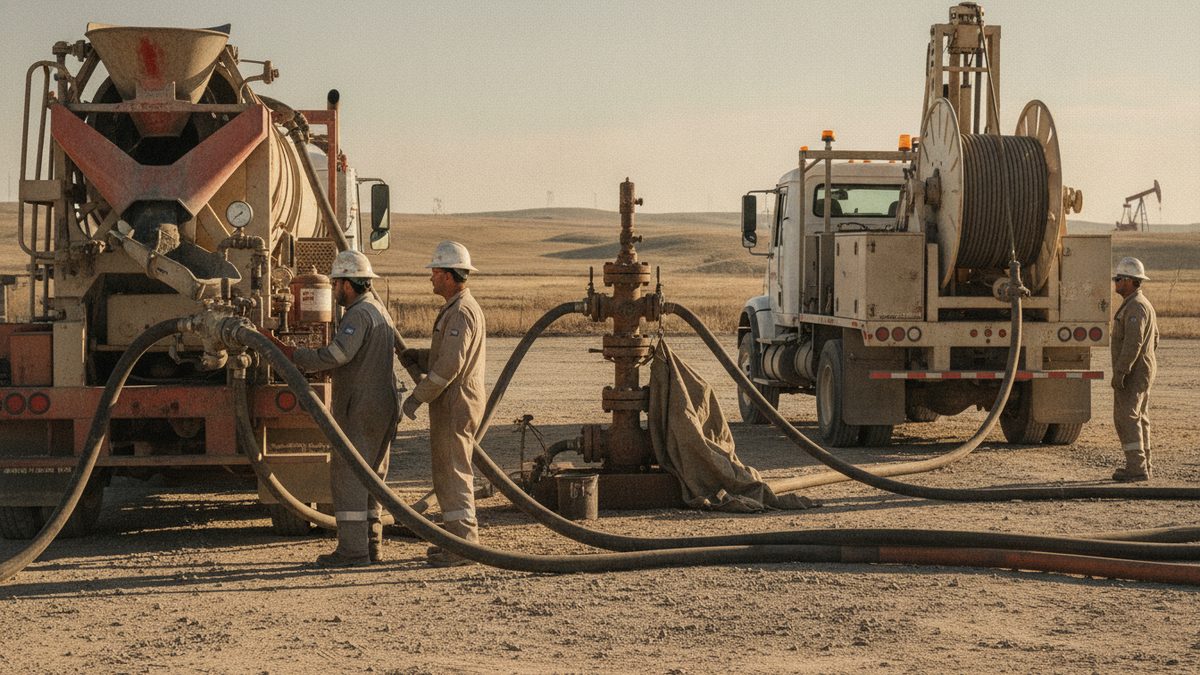
How Do You Plug and Abandon a Well? The Barrier Philosophy
Every abandonment is built on the same principle: two independent, verified barriers between any flow-capable formation and the surface or seabed. Independent means that the failure of one cannot cause the failure of the other. Verified means tested and logged, not assumed.
Step 1: Establish What You Are Sealing Against
Before any cement is pumped, the engineer identifies every permeable, flow-capable zone the wellbore crosses, and the pressure in each. This comes from the original well records, offset data and, where the records are poor, from logging the well again. Old wells are the hard case. Records from the 1970s are frequently incomplete, and assumptions made at this stage propagate through the entire programme.
Step 2: Verify the Existing Cement, Then Decide What to Remove
If the original annular cement is competent across a caprock, it can serve as part of a barrier and save an enormous amount of work. Cement evaluation logging tells you whether it is. Where the cement is absent or channelled, the options are to perforate, wash and cement in place, or to pull the casing and set a rock-to-rock plug. That decision is usually the single largest cost driver in the whole programme.
Step 3: Set, Test and Document the Barriers
Plugs are set in sequence from the deepest reservoir upward, each one tagged and pressure tested. An environmental barrier is placed near surface, tubing and wellhead are recovered, and the casing is cut below ground or seabed level. The abandonment report then has to demonstrate to the regulator that every barrier meets the standard, which in practice means the logging and test records matter as much as the cement itself.
| Barrier type | Purpose | Typical means |
|---|---|---|
| Primary reservoir barrier | Isolates the producing formation | Cement plug across perforations, or squeeze and plug |
| Secondary reservoir barrier | Independent backup to the primary | Second plug above, or verified annular cement across caprock |
| Intermediate barriers | Prevents cross-flow between shallower permeable zones | Plugs set at casing shoes or across the zone |
| Environmental barrier | Stops shallow migration to surface or seabed | Near-surface cement plug |
| Physical removal | Removes navigation and land-use hazard | Casing cut below ground or seabed, wellhead recovered |
Which Standard Governs Your Abandonment?
There is no single global abandonment standard. The barrier principle is close to universal, but the detail of what counts as an acceptable barrier, how long it must be, and what evidence the regulator will accept varies by jurisdiction. Getting this wrong is expensive, because the work may have to be redone.
| Region | Governing framework | Practical character |
|---|---|---|
| UK Continental Shelf | NSTA regulatory regime, with industry guidelines published by Offshore Energies UK | Guideline-led and risk-based. The operator proposes a design and justifies it, rather than following a fixed recipe. |
| Norwegian Continental Shelf | NORSOK D-010 | The most prescriptive of the major regimes, and widely used as a reference standard well outside Norway. |
| US Outer Continental Shelf | BSEE regulations under 30 CFR 250 | Rule-based, with specified plug lengths and placement requirements. |
| US onshore | State regulators, which differ considerably between states | Requirements vary by state, so the governing rule depends on where the well sits. |
| Most other regions | National regulator, frequently referencing NORSOK D-010 or operator internal standards | Where local regulation is light, the operator’s own standard usually becomes the binding one. |
Two practical consequences follow. First, an engineer’s experience is not automatically portable between regimes. Someone fluent in NORSOK will still need to learn how a risk-based UK submission is argued, and vice versa. Second, in regions where national regulation is thin, the operator’s internal standard is what actually governs the work, and it is usually derived from NORSOK or BSEE anyway.
For engineers working internationally, the useful skill is the ability to read any of these frameworks and extract the same three questions: how many barriers, what qualifies as independent, and what evidence proves it. That is a well integrity competency before it is a regulatory one.
How Much Does It Cost to Plug and Abandon an Oil Well?
The range is enormous, and anyone quoting a single figure is describing one specific well type rather than the discipline. The variables that matter most are where the well is, whether a rig is required, and how good the original records and cement are.
| Well type | What drives the cost |
|---|---|
| Shallow onshore | Rig-less or workover-unit operation, short duration. The cheapest category by a wide margin, often completed in days. |
| Onshore deep or poorly documented | Logging to re-establish well condition, possible casing recovery. Poor records are the main cost multiplier. |
| Offshore platform well | Platform rig time dominates. Multiple wells are batched to spread mobilisation. |
| Subsea well | The most expensive category. Requires a rig or intervention vessel, plus wellhead and infrastructure removal. |
For scale, the North Sea Transition Authority estimates that £43.4 billion of decommissioning spending remains on the UK Continental Shelf, with well plugging and abandonment accounting for roughly half of it. In 2025 alone, UK operators spent around £1.3 billion on well decommissioning, working on more than 250 wells, of which just over 100 reached final abandonment.
Those numbers explain why cost reduction dominates the discipline. The same regulator estimates that using intervention vessels rather than drilling rigs for subsea wellhead removal could cut the remaining cost of that activity by roughly 30 per cent. Engineers who can credibly reduce rig days are the ones operators want.
Well Integrity Management Training
Barrier philosophy, integrity assessment and the verification methods that abandonment work is built on. Covers barrier definition and testing, annulus pressure diagnosis, cement evaluation and the integrity case through to end of life. The technical foundation for anyone moving into decommissioning.
$5,250 per attendee. London, Houston or Dubai.
View Dates & BookWhat a Well Abandonment and Decommissioning Engineer Does
The role blends well engineering with project management and regulatory work. In smaller organisations it sits inside the well engineering team; in larger ones it is a dedicated decommissioning group.
Core Responsibilities
- Reconstructing well history from incomplete records, and deciding what has to be re-logged before work starts
- Writing the abandonment programme and the barrier design, then defending both to the regulator
- Selecting the intervention method: rig, workover unit, intervention vessel or rig-less, which is where most of the cost sits
- Sequencing multi-well campaigns so mobilisation is shared and the learning curve is captured
- Managing cement, wireline, tubing recovery and casing cutting contractors
- Owning the environmental case and the waste and materials disposal plan
- Producing the close-out documentation that transfers the well out of the operator’s active liability
- Tracking cost against estimate on a scope where overruns are common and scrutinised
One feature of the work is unusual and worth naming. There is no production upside. Nothing the engineer does will make money. Every decision is judged on whether it met the standard at acceptable cost, which suits engineers who take satisfaction in doing something properly and permanently, and frustrates those who want their work measured in barrels.

Well Integrity: The Skill That Underpins Abandonment
Abandonment is, in engineering terms, the final act of well integrity management. The same questions run through both: where are the barriers, are they independent, how do you prove they are intact, and what do you do when one is not.
That is why engineers moving into decommissioning are usually advised to build the integrity foundation first. Barrier definition and verification, sustained annulus pressure diagnosis, and cement evaluation are the working vocabulary of abandonment, and they are learned in an integrity context.
An Honest Note on Scope
We do not currently run a dedicated plug and abandonment or decommissioning project course. Well Integrity Management Training is the closest fit, and it covers the barrier and verification engineering that abandonment depends on, but it is not a course in P&A project execution or decommissioning cost management.
If decommissioning project delivery is specifically what you need, tell us. We build bespoke and in-house courses around a client’s actual scope, and this is an area where demand is clearly growing.
“It is nice to attend such course that is close to my career and enhance my knowledge.”
Assistant Programmer, Medco Energy (Oman) · Well Production Enhancement Training
Skills, Qualifications and Career Path
Almost nobody starts here. Decommissioning is a second-half-of-career discipline, entered by engineers who already understand how wells are built.
What Employers Expect
- Degree. Petroleum, mechanical or chemical engineering, as for well engineering generally
- Well engineering experience. Typically five years or more in drilling, completions or well intervention before specialising
- Cementing and casing competence. Cement placement, evaluation and remediation are the core technical content
- Well control certification. IWCF or IADC WellSharp, current, because abandonment operations still involve live wells
- Regulatory literacy. The applicable standard differs by jurisdiction, and knowing which one governs your well is part of the job
- Cost and contract management. The work is judged on cost performance against an estimate, so commercial competence is not optional
| Stage | Typical route | What changes |
|---|---|---|
| Years 0, 5 | Drilling, completions or intervention engineer | Building the well construction and cementing foundation. No decommissioning exposure yet. |
| Years 5, 10 | Well integrity or intervention engineer | Barrier verification, annulus pressure diagnosis, suspension work. First abandonment programmes under supervision. |
| Years 10, 15 | Decommissioning / abandonment engineer | Owning well abandonment programmes and regulatory submissions. Campaign sequencing. |
| Years 15 + | Decommissioning manager / late-life asset lead | Whole-asset decommissioning, multi-year budgets, regulator and stakeholder interface. |
The discipline travels unusually well. Decommissioning expertise built in the North Sea is directly applicable in the Gulf of Mexico, West Africa and Southeast Asia, because the barrier engineering is the same even where the regulation differs. It also transfers into carbon storage, where proving that a well will not leak for geological time is precisely the same problem statement.
Training for Well Integrity and Decommissioning
Build the technical foundation in the order the work uses it.
| Priority | Capability | Where it comes from |
|---|---|---|
| 1 | Barrier philosophy and integrity verification | Well Integrity Management |
| 2 | Cement placement, evaluation and remediation | Remedial Cementing and Cement Evaluation |
| 3 | Casing and primary cementing fundamentals | Casing and Cementing |
| 4 | Intervention and tubing recovery technique | Workover and Completions |
| 5 | Pipeline and facility decommissioning context | Pipeline Integrity Management |
All of these sit within our drilling engineering course catalogue, which runs to twenty-five courses across well construction, integrity and operations. Engineers working on ageing assets should also look at the health and safety training hub, since late-life operations carry a different risk profile from routine production.
Integrity work also overlaps heavily with the wider asset integrity discipline. If your remit covers facilities as well as wells, our guide to the asset integrity engineer role covers the adjacent career path.
Well Integrity Management Training at a Glance
- Five days, classroom delivery in London, Houston or Dubai
- $5,250 per attendee, with volume discounts for cohorts
- Covers barrier definition and testing, annulus pressure diagnosis, cement evaluation and the well integrity case to end of life
- Delivered by instructors with active field experience, using case studies from live operations
- Accredited by the British Accreditation Council and the CPD Standards Office London, so the hours count toward chartership
Related Integrity and Intervention Courses
Book Well Integrity Management Training
Five days on the barrier engineering that abandonment depends on: barrier definition and testing, sustained annulus pressure diagnosis, cement evaluation and building a defensible well integrity case. You will leave able to assess whether a barrier is genuinely independent and verified, and to document why.
Five-day intensive. From $5,250 per attendee. Available in London, Houston and Dubai, or in-house at your site. BAC and CPD Standards Office London accredited.
Volume and group discounts available for cohorts. Ask us for a quote.
Frequently Asked Questions
What Does It Mean When A Well Is Plugged And Abandoned?
It means the well has been permanently sealed with verified barriers so that no fluid can migrate between formations or reach surface, and it has been signed off as needing no further monitoring. The wellhead is normally cut below ground or seabed level and removed. Unlike a suspended well, there is no intention to re-enter it.
How Much Does It Cost To Plug And Abandon An Oil Well?
It varies by orders of magnitude. A shallow onshore well handled by a workover unit is the cheapest case and can be completed in days. A subsea well requiring a rig or intervention vessel plus wellhead removal is the most expensive. For scale, the North Sea Transition Authority estimates £43.4 billion of UK decommissioning spending remains, with well plugging and abandonment accounting for around half of it, and UK operators spent roughly £1.3 billion on well decommissioning in 2025.
How Do You Plug And Abandon An Oil Well?
You establish two independent, verified barriers between every flow-capable formation and surface. In practice that means identifying all permeable zones from the well records, logging the existing annular cement to see whether it can serve as a barrier, then setting and pressure testing cement plugs in sequence from the deepest reservoir upward. An environmental barrier is placed near surface, tubing and wellhead are recovered, and the casing is cut below ground or seabed level.
What Is The Difference Between Well Abandonment And Decommissioning?
Well abandonment refers specifically to permanently sealing the wellbore. Decommissioning is the wider programme that includes abandoning the wells but also removing platforms, subsea equipment and pipelines, and restoring the site. Well P&A is normally the largest single component of a decommissioning budget.
Is Decommissioning A Good Career In Oil And Gas?
It is one of the few areas with structurally growing demand, because the workload is set by the existing stock of ageing wells rather than by commodity prices. That makes it more counter-cyclical than most upstream disciplines. The skills also transfer directly into carbon storage, where proving long-term well sealing is the same engineering problem.
What Qualifications Do You Need For Well Abandonment Engineering?
A petroleum, mechanical or chemical engineering degree, followed by several years in drilling, completions or well intervention. Current well control certification through IWCF or IADC WellSharp is expected, since abandonment operations still involve live wells. Beyond that, the specific competencies are cementing, cement evaluation, barrier verification and the regulatory standard applicable in your jurisdiction.
Why Are Old Wells Harder To Abandon Than New Ones?
Because the records are worse. Wells drilled decades ago frequently have incomplete cement records, uncertain casing condition and poorly documented shallow zones. That forces the engineer either to re-log the well to establish its actual condition, or to design conservatively and pull casing that might not have needed pulling. Both add cost, and record quality is often the single biggest variable in an abandonment estimate.