


TLDR
A production chemist designs, runs and monitors the chemical treatments that keep oil and gas wells flowing: wax and asphaltene control, scale and corrosion inhibition, hydrate management, demulsifiers and biocides. The role sits at the intersection of analytical chemistry, flow assurance and field operations.
This post covers what the role looks like in practice, the tests and treatments you will run, the skills operators hire for, typical 2026 salary ranges, and the fastest CPD-accredited route into the specialism.
What a production chemist actually does
If you are a chemistry graduate looking at oilfield jobs, or a process engineer who has just inherited a flow-assurance problem your team cannot solve with bigger pipes, the role you are looking at is the production chemist. Production chemistry is what stops a well that should be making money from sitting shut-in because a flowline is half-blocked with paraffin or a separator is off-spec because of a stable emulsion that nobody can break.
On a given week, a production chemist might:
- Specify and design the chemical injection programme for a new completion: which inhibitors at which dose rates, where to inject downhole or topside, and how to measure that they are working.
- Diagnose a sudden production loss by running cloud-point, pour-point and asphaltene-stability tests on a fresh sample, and ruling out wax, scale or asphaltene as the root cause.
- Run laboratory bottle tests to qualify a new corrosion inhibitor or demulsifier against the specific crude on the asset.
- Sit in with the production engineer and the field supervisor to plan a hot-oil treatment, a pigging campaign, or a chemical clean-out for a well that has gone offline.
- Write the residual-monitoring protocol that keeps the chemical spend honest: too little inhibitor and the asset corrodes, too much and the operating cost balloons.
- Brief the integrity team on what the corrosion-coupon results mean for the next inspection cycle.
The job is more diagnostic than it looks from the outside. A good production chemist treats every well as its own chemistry problem, rather than rolling a generic treatment plan from one asset to another.
The chemistry problems you will spend most of your time on
Most of the work falls into six categories, and a competent production chemist works across all of them.
- Wax and paraffin deposition: cloud-point and wax-appearance temperature, pour-point behaviour, deposition in tubing, flowlines, chokes and stock tanks. Treatments span mechanical (pigging, scrapers), thermal (hot oil, line heaters) and chemical (solvents, dispersants, crystal modifiers).
- Asphaltene precipitation: destabilisation of asphaltene micelles in flowing systems, formation damage from CO2 floods or HCl treatments, deposition in ESPs and surface vessels, and the chemistry to keep them peptised.
- Scale management: carbonate, sulphate and sulphide scales from incompatible waters, scaling indices, threshold inhibitors, squeeze treatments and chemical compatibility testing.
- Corrosion control: CO2 and H2S corrosion mechanisms, materials versus chemistry trade-offs, inhibitor selection, residual monitoring and corrosion coupons.
- Hydrate management: thermodynamic versus kinetic inhibitors, methanol and MEG injection, and the calculation work to size dose rates for a given pressure-temperature envelope.
- Emulsions, foams and water treatment: demulsifier selection, antifoam programmes, oil-in-water specs, produced-water reinjection chemistry.
Of those, paraffin and asphaltene are the two that take down more wells than any other and are the hardest to predict from a desk. Mobility’s training catalogue puts them together for that reason: the Paraffin and Asphaltene course covers both the diagnostic chemistry and the field-treatment options across reservoir, wellbore and surface equipment.
Skills and qualifications operators actually hire for
Most postings ask for a BSc or MSc in Chemistry, Chemical Engineering, Petroleum Engineering, or a related discipline. Chartership through the Royal Society of Chemistry, IChemE, Energy Institute or SPE is increasingly expected for senior roles. Beyond the degree, hiring managers look for a specific stack:
- Crude characterisation: SARA fractionation, gas chromatography, FT-IR, viscosity-temperature behaviour, API gravity and the chemistry that sits behind those numbers.
- Treatment-chemistry fluency: scale, wax, asphaltene, corrosion and hydrate inhibitors, plus demulsifiers and antifoams. Knowing what works on what crude is half the job.
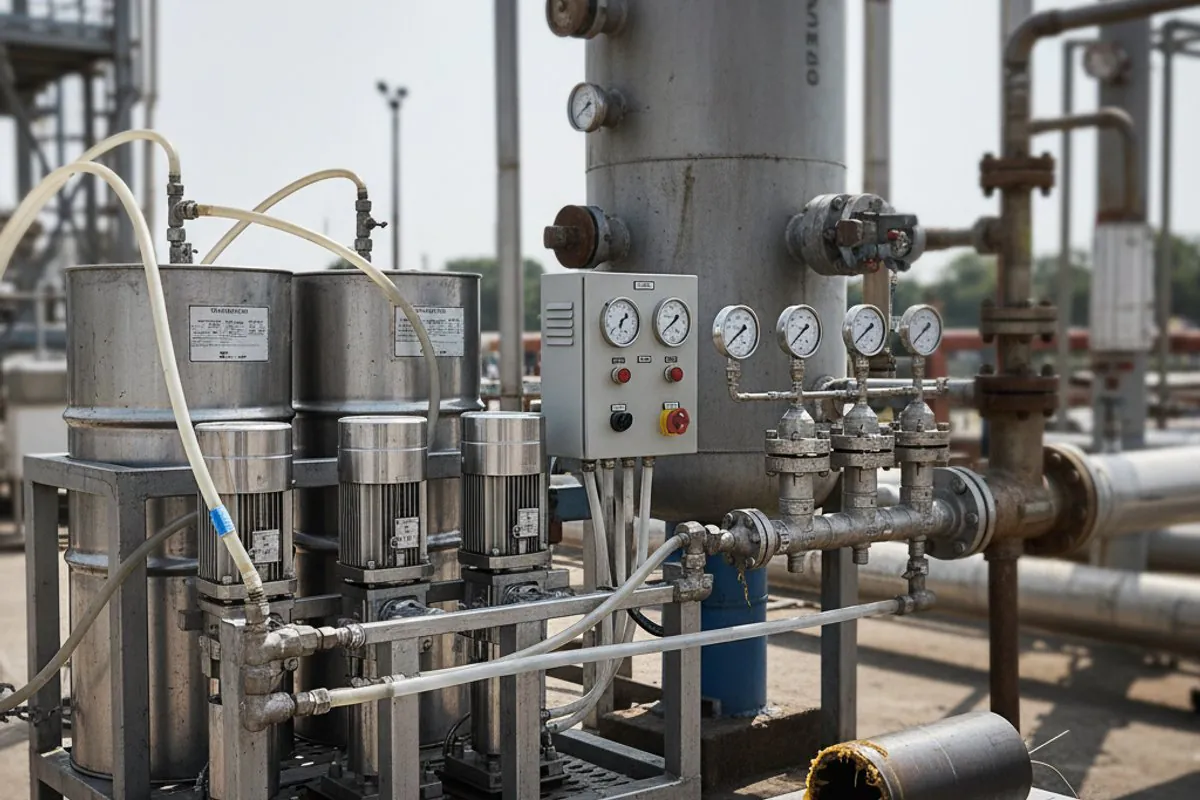
- Field-operations literacy: chokes, flowlines, separators, ESPs, gunbarrel tanks. You cannot specify a treatment without understanding the equipment it has to survive.
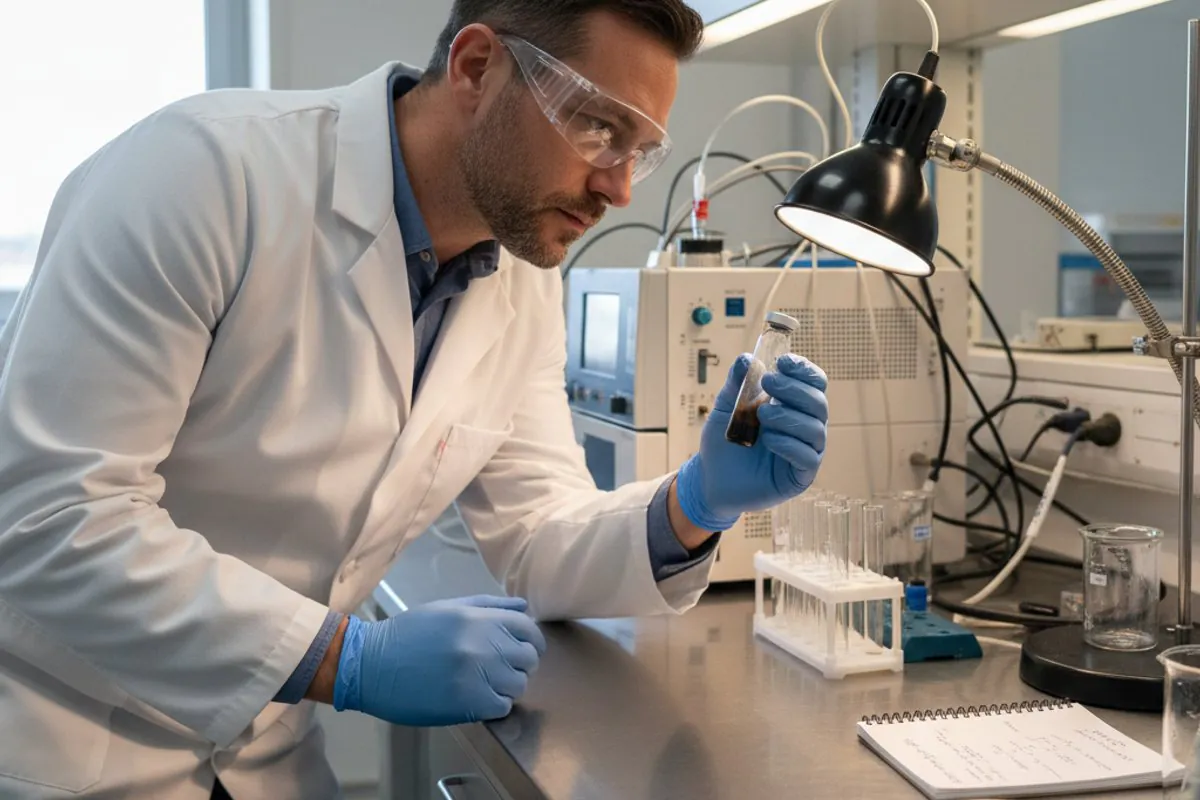
- Laboratory technique: cloud-point and pour-point measurement, asphaltene stability tests, bottle testing, compatibility screening.
- Modelling and software: PVTsim or Multiflash for fluid behaviour, OLGA or LedaFlow for multiphase flow, scale-prediction tools, and a working comfort with the spreadsheets that keep dose rates honest.
- Field credibility: the production chemist who can hold a working conversation with a field operator about why their new treatment plan is going to land better than the last one is the one who gets called first when something goes wrong.
For teams moving into a new fluid type, light condensate moving to heavier crude, or a sour gas asset coming online, a structured short course is the fastest credible route to getting the chemistry team to a common baseline.

Flow Assurance (Upstream) Training
The five-day flow assurance course most production chemists do alongside the chemistry-specific training. Multiphase flow regimes, hydrate management, blockage prediction, software workflows and the project-decision interfaces production chemistry has to feed into.
From $5,250 per attendee · Dubai, Houston, London, Online · BAC and CPD Standards Office London accredited.
View Dates and Book“A useful course for my field research.”
Chemist, NTC NIS-NAFTAGAS: Paraffin and Asphaltene in the Oil and Gas Industry Training
Where production chemists work
The role splits across two main employers, and the work feels different on each side.
Operator-side: employed by majors (Shell, BP, TotalEnergies, ExxonMobil, Chevron), NOCs (Aramco, Petrobras, ADNOC, Pemex, Kuwait Energy) or mid-cap independents. Production chemists on the operator side typically own the chemistry programme across one or more assets, working with operations, integrity and the chemical service company. Career progression runs production chemist → senior production chemist → technical authority or asset chemistry lead.
Service-side: employed by the production-chemicals divisions of SLB, Halliburton, Baker Hughes (now part of ChampionX), Nalco Champion, Clariant, Innospec or BASF. Service-side chemists run the field application, qualify products in the lab, and sit alongside operator chemists at field reviews. Career progression runs field chemist → account or technical manager → product development or commercial roles. The service-side route is one of the cleaner paths into production chemistry for a fresh chemistry graduate.
Salary, location and how the market looks in 2026
Compensation varies by region, employer, and offshore exposure. Broad 2026 ranges from public job boards:
- Entry level (0 to 3 years): roughly £35,000 to £50,000 in the UK, $65,000 to $90,000 in the US Gulf, and equivalent local packages in the Middle East with housing and uplift allowances.
- Mid-level (4 to 9 years): typically £55,000 to £85,000 in the UK, $100,000 to $140,000 in the US, with offshore rotation adding 20 to 40 per cent on top.
- Senior (10+ years, chartered): £90,000 to £135,000 plus benefits in the UK, $150,000 to $210,000 in the US, with technical-authority and chief-chemist roles at the top end.
The strongest 2026 markets are the Middle East (sour gas and heavy oil chemistry), the North Sea (mature-field corrosion and integrity programmes), West Africa (deepwater asphaltene and hydrate work), and the US Permian and Eagle Ford (high-volume completions chemistry). Demand for production chemistry skills is also growing in carbon storage and geothermal, where corrosion and scale chemistry transfer almost directly.
How to move into the role
There are three honest paths into production chemistry, and they are not mutually exclusive:
- From a chemistry or chemical engineering degree: you have the lab fundamentals. What you need is the industry-specific knowledge of crude composition, treatment chemistries and the field operations they have to survive. A focused short course closes that gap in a week.
- From process or production engineering: you understand the equipment and the operations. What you need is the chemistry depth, particularly the diagnostic side: cloud point, pour point, asphaltene stability, scale prediction. A structured short course is faster than picking it up from papers.
- From a service-company lab role: you have run more bottle tests than most operator chemists at your grade. What you need is the integrated field-application context to make the step to operator-side credible. A CPD-accredited certificate visibly helps that pivot.
Adjacent competencies help. A working understanding of the Royal Society of Chemistry’s chartership routes and the IChemE chartered chemical engineer pathway is worth checking against your specific employer’s competency framework. Either route counts for CPD on Mobility’s accredited courses.
Paraffin and Asphaltene Training
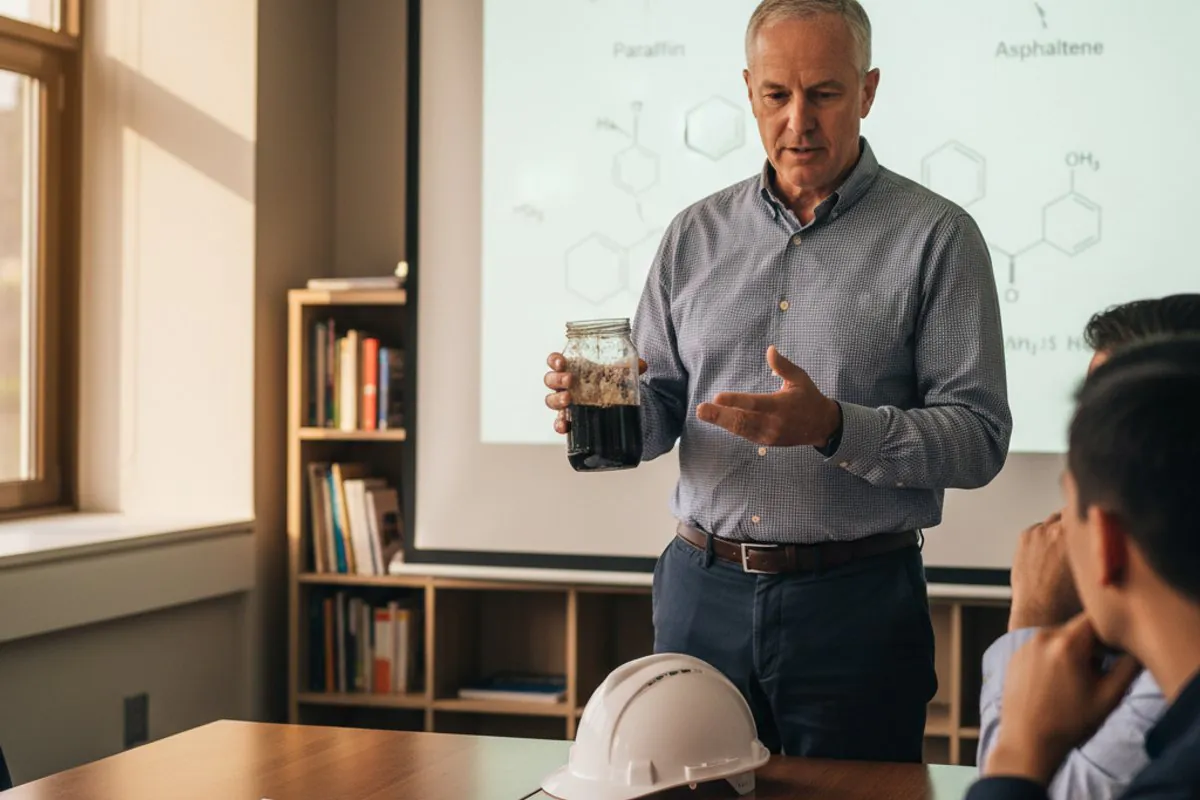
The five-day specialism on the two chemistry problems that take down more wells than any other. Cloud-point and pour-point analysis, asphaltene stability, formation damage mechanisms, EOR-related issues, treatment chemistries from solvents to crystal modifiers, and the cost-effective treatment-selection workflow senior production chemists use.
From $5,250 per attendee · Houston, Dubai, London · BAC and CPD Standards Office London accredited.
View Dates and BookWhy Mobility for production chemistry
Accredited by the British Accreditation Council and the CPD Standards Office London. UKRLP registration 10047196. Hours count toward chartership.
Production chemistry programmes have trained engineers from ExxonMobil, Repsol, Pemex, PDVSA, Kuwait Energy and NIS-Naftagas. The Paraffin and Asphaltene course is delivered by an instructor with decades of operator and service experience on real wells, not lecture-hall chemistry.
What a five-day course can and cannot do
A short course will not, on its own, make someone into a senior production chemist. That takes reps: enough wells, enough fluid types, enough failed treatments to build the pattern-matching that experienced chemists use without thinking. What a good five-day intensive does is compress the diagnostic chemistry, the treatment selection logic, and the case-study patterns into a focused week, so that when the real problems arrive you are not starting from a blank page with a producing field waiting on your answer.
If your asset is moving into a new fluid regime, asphaltene-prone crude in deepwater, sour gas with H2S corrosion, or a CO2 EOR project that risks destabilising what was a stable asphaltene system, a structured course is the fastest credible way to get the chemistry team to a common baseline. The competencies are concrete and the cost of getting them wrong is measured in barrels deferred, not in training spend.
Related Courses
Book the Paraffin and Asphaltene Training
A five-day intensive on the two chemistry problems that take down more wells than any other. Cloud point, pour point, asphaltene stability, formation damage, treatment selection and the cost-effective workflow senior production chemists use.
Five-day intensive. From $5,250 per attendee. Available in Houston, Dubai and London. BAC and CPD Standards Office London accredited.
Volume and group discounts available for cohorts. Ask us for a quote.
Frequently Asked Questions
What is the difference between a production chemist and a flow assurance engineer?
A flow assurance engineer owns the broader question of whether fluids will move from reservoir to processing under all expected conditions. A production chemist owns the chemistry side of that question: what additives keep wax, scale, asphaltene, hydrate and corrosion under control, and at what dose. On smaller teams the same person does both. On larger assets they are paired roles.
Do I need a chemistry degree to become a production chemist?
Most postings ask for chemistry, chemical engineering or petroleum engineering. A chemistry degree is the most common starting point, but petroleum or chemical engineers do move into the role with a structured short course to fill in the analytical-chemistry gap.
Which software should a production chemist know?
PVTsim or Multiflash for fluid behaviour, OLGA or LedaFlow for multiphase flow, scale-prediction tools (ScaleSoftPitzer, OLI), and the spreadsheet workflows that govern dose-rate calculations. Hiring managers care more about your interpretation quality than which specific vendor’s tool you learned on.
Is production chemistry a good career in the energy transition?
The core skills, fluid characterisation, corrosion chemistry, scale management and treatment design, transfer almost directly into carbon storage (CO2 corrosion and well integrity), geothermal (scale and corrosion in high-temperature brines) and underground hydrogen storage (sealing and reactivity chemistry). Operators running those projects are actively hiring people with conventional production chemistry backgrounds.
What are the hardest skills for a new production chemist to pick up?
In practice, three things: predicting asphaltene stability across changing pressure-temperature paths in a flowing system, selecting a corrosion-inhibitor programme that holds across multiple operating regimes, and writing a treatment plan that field operators can actually execute without daily back-and-forth. All three are covered in a focused course, but they only become instinctive with reps on real wells.
Can a process engineer move into production chemistry?
Yes, and it is one of the cleaner lateral moves. You already understand the equipment, the units and the operating envelope. The gap is on the analytical chemistry side, particularly diagnostic testing and treatment-chemistry selection. A structured short course closes that gap quickly.
How long does it take to become a senior production chemist?
Typically 8 to 12 years of relevant practice, with at least five of those owning the chemistry programme on at least one full asset. Chartership through the Royal Society of Chemistry, IChemE or the Energy Institute usually lands somewhere in that window and is the formal marker most operators look at for senior or technical-authority roles.