


TLDR
A well testing engineer designs, runs and interprets the pressure and flow tests that tell an operator what a well and its reservoir can actually do. It is one of the most quantitative roles in upstream oil and gas, sitting between reservoir engineering, production engineering and field operations.
This post covers what the role looks like in practice, the tests you will run, the skills and qualifications operators expect, typical salary ranges, and the fastest CPD-accredited route into the specialism.
What a well testing engineer actually does
If you are a reservoir or production engineer whose manager has just said, “we need someone to own the well test programme on this asset,” the gap you are looking at is real. Well testing is a discipline in its own right, and the people who can design a clean test, spot a wellbore storage distortion on a derivative plot, and tell the field supervisor when the data is good enough to stop are paid accordingly.
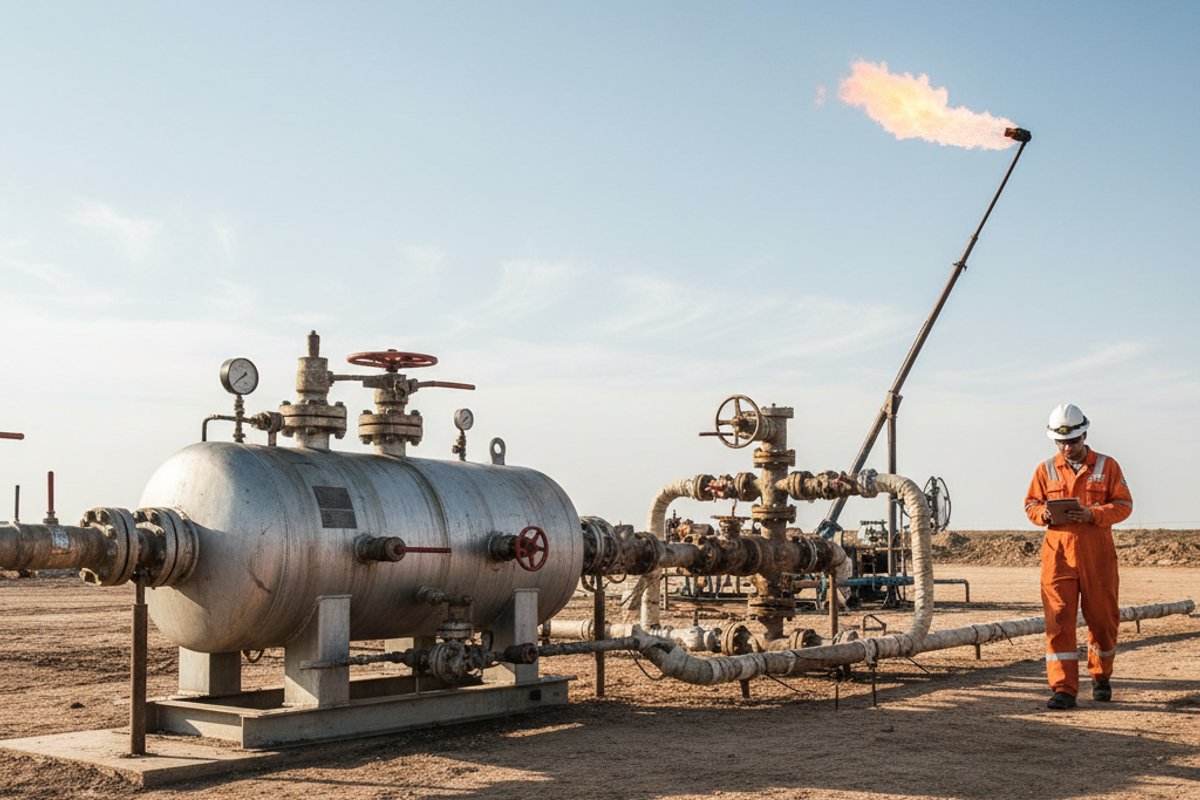
On a given week, a well testing engineer might:
- Design a build-up or drawdown test for an exploration well: choke sequence, duration, gauge selection, surface equipment, safety case.
- Review real-time downhole pressure and temperature data during the test and call whether to extend, stop, or re-run.
- Interpret the resulting pressure transient data using Horner and derivative plots, and extract the permeability, skin, reservoir boundaries and, where relevant, fracture properties.
- Write the test report that goes to the reservoir engineer, the field development team and, in some cases, the regulator.
- Sit in with completion and production engineers to discuss what the test says about the well’s future performance, likely drawdown, and any formation damage the completion design will have to work around.
The output is rarely a single answer. A good well testing engineer hands over a range, states the assumptions clearly, and names the tests they would run next to tighten the uncertainty.
The tests you will spend most of your time on
Most of the work falls into six buckets, and a competent well testing engineer can move between them with a clear framework for each.
- Pressure Build-up and Drawdown Tests: the core transient tests used to estimate permeability, skin and reservoir boundaries. Horner plots and derivative analysis do most of the heavy lifting.
- Drill Stem Tests (DST): run during exploration and appraisal to get an early read on productivity before a full completion. Applications and limitations matter: the interpretation has to respect what the tool physically measures.
- Gas Well Deliverability Tests: isochronal and modified-isochronal tests, absolute open flow potential, turbulent flow terms. Gas wells behave differently from oil wells and the theory reflects that.
- Interference and Pulse Tests: multi-well tests that tell you about connectivity between wells, which matters for waterflood and gas-injection design.
- Horizontal and Fractured Well Tests: linear, elliptical and pseudo-radial flow regimes, fracture length and conductivity, hydraulic fracture diagnosis. Interpreting these is harder than vertical-well interpretation and it is where many junior engineers struggle.
- Naturally Fractured Reservoir Tests: carbonates and fractured basement reservoirs, double-porosity behaviour, storativity and matrix-fracture porosity partitioning.
On top of those, more senior well testing engineers work with de-convolution techniques to recover the underlying reservoir response from noisy, variable-rate data, and with well test modelling software to history-match complex tests against reservoir simulation. You can see the full syllabus Mobility’s engineers work through on the Advanced Well Test Analysis Training page.
Skills and qualifications operators actually hire for
Most job postings want a BSc or MSc in Petroleum Engineering, Reservoir Engineering, Chemical Engineering, or a related discipline. Chartership through the Energy Institute, IMechE or SPE is increasingly expected for mid-senior roles and is effectively a requirement on NOC contracts. Beyond the degree and chartership path, hiring managers look for a specific stack of skills:
- Pressure transient analysis (PTA) fundamentals: Darcy’s law, the diffusivity equation, transient vs pseudo-steady vs steady state, wellbore storage, skin, radius of investigation.
- Interpretation software: Saphir (KAPPA), Pansystem, Ecrin, or the well test modules of a reservoir simulator. You will be expected to be productive in at least one.
- Familiarity with surface and downhole gauge technology: memory gauges, real-time gauges, electronic memory tools, and their accuracy and drift envelopes.
- Working knowledge of completions: you cannot interpret a test cleanly without understanding the completion through which the data was collected.
- Report-writing and technical communication: well test reports land in front of non-specialists (asset managers, regulators, joint venture partners) and have to hold up to scrutiny from specialists.
- Field credibility: ability to hold a conversation with a field supervisor, a mud engineer, and a flow back team. Pure desk-based PTA without any field time is increasingly rare.
For teams moving into an unfamiliar regime, high-pressure high-temperature wells, deepwater appraisal, or horizontal wells in tight reservoirs, a structured short course is the fastest honest route to getting a group of engineers on the same interpretation baseline.

Petroleum Reservoir Engineering
The reservoir engineering course most well testing engineers do before specialising. Five days on rock and fluid properties, material balance, decline analysis, recovery mechanisms and the integrated workflow your test data ultimately feeds.
From $5,250 per attendee · 5 locations available · BAC and CPD Standards Office London accredited.
View Dates and Book“Good course. I learnt about ICDs and ICVs system with new and old fashion multiphase sensors. Also, case studies of intelligent, Reservoir Monitoring, subsea system etc my opinion in all is very good.”
Production Engineer, Kuwait Energy Egypt: Intelligent Completions Training
Where well testing engineers work
The role splits broadly into two sub-tracks that often overlap early in a career and separate later.
Operator-side: employed by majors (Shell, BP, TotalEnergies, ExxonMobil, Chevron), NOCs (Petrobras, Pemex, Saudi Aramco, PDVSA, Kuwait Energy), or mid-cap independents. Work spans exploration and appraisal campaigns, development well testing, and ongoing reservoir surveillance on producing fields. The career progression typically runs well testing engineer → senior reservoir engineer → subsurface team lead.
Service-side: employed by SLB, Halliburton, Baker Hughes, Expro, or specialist well testing service companies. The work is more operational and rig-adjacent, with heavier field rotations. Career progression runs field engineer → senior engineer → operations or technical manager. The service-side background often becomes a sought-after asset when moving to the operator side later, because you have seen far more wells than most desk-only engineers will in a lifetime.
Salary, location, and how the market looks in 2026
Compensation varies widely by region, operator or service employer, and offshore or rotation exposure. Broad 2026 ranges seen on public job boards:
- Entry level (0 to 3 years): roughly £38,000 to £55,000 in the UK, $70,000 to $95,000 in the US Gulf, and equivalent local packages in the Middle East with housing and uplift allowances.
- Mid-level (4 to 9 years): typically £60,000 to £90,000 in the UK, $110,000 to $150,000 in the US, with offshore rotation adding 20 to 40 per cent on top.
- Senior (10+ years, chartered): £95,000 to £140,000 plus benefits in the UK, $160,000 to $220,000 in the US, with principal-engineer and technical-authority roles at the top end.
The strongest markets in 2026 remain the North Sea (brownfield surveillance, late-life reservoir management), the Middle East (carbonate and fractured reservoirs, deliverability testing on gas), West Africa (deepwater appraisal), Latin America (pre-salt and conventional onshore), and Guyana (ongoing appraisal campaigns). Work in geothermal and carbon storage is growing and draws directly on well testing skills, which is worth keeping in view if you are planning the next five years rather than the next one.
How to move into the role
There are three honest paths in, and they are not mutually exclusive:
- From reservoir engineering: you already have the theory. What you need is real test-interpretation reps, software fluency, and exposure to the full range of test types, including fractured wells and gas deliverability. A focused short course with worked case studies closes this gap in about a week of intensive study.
- From production or completions engineering: you know the completion hardware and the field environment. The gap is usually on the analytical side, particularly derivative analysis and de-convolution. Again, a structured course is faster than trying to piece it together from papers.
- From the service-company field side: you have seen more gauges and more test jobs than anyone on the operator side at your grade. What you need is the formal interpretation and reporting framework so the career step across is credible. A CPD-accredited certificate makes a visible difference on the CV here.
Adjacent competencies help. A working understanding of reservoir engineering fundamentals and petrophysics and log interpretation lets you read the geological and petrophysical inputs that feed your tests and feeds the integrated reservoir-characterisation work that senior roles lead. The formal chartership step is documented through the Energy Institute’s Chartered Petroleum Engineer route, which most operators recognise alongside SPE membership.

Advanced Well Test Analysis Training
Five-day intensive on pressure transient interpretation, covering vertical and horizontal wells in conventional, fractured and gas reservoirs. Worked case studies, real datasets, and the de-convolution techniques senior well testing engineers use every week.
From $5,250 per attendee · London, Online, Houston, Dubai · BAC and CPD Standards Office London accredited.
View Dates and BookWhy Mobility for well testing
Accredited by the British Accreditation Council and the CPD Standards Office London. UKRLP registration 10047196. Hours count toward chartership.
Engineers from ExxonMobil, Repsol, Pemex, PDVSA, Kuwait Energy and Romgaz have trained with Mobility. The Advanced Well Test Analysis Training is delivered by instructors who have sat in test vans on live wells, not only lectured about them.

What a five-day course can and cannot do
A short course will not, on its own, make someone into a senior well testing engineer. That takes reps, field exposure, and a handful of tests that went wrong and taught you why. What a good five-day intensive does is compress the interpretation theory, the software fluency, and the case-study pattern-matching into a single focused week, so that when the real tests arrive you are not learning on the job with a regulator and a field supervisor waiting on your answer.
If your asset is moving into HPHT testing, or your team is picking up horizontal-well appraisal for the first time, a structured course is the fastest credible way to get engineers to a common baseline. It is also one of the easier CPD spends to justify, because the competencies are concrete and testable.
Related Courses
Book the Advanced Well Test Analysis Training
A five-day intensive covering the interpretation theory, software patterns and case studies that a working well testing engineer uses every week. Led by instructors with live-well test experience, not lecture-hall theory.
Five-day intensive. Classroom or online, same accreditation weight. Scheduled in London, Online, Houston and Dubai in 2026. BAC and CPD Standards Office London accredited.
Volume and group discounts available for cohorts. Ask us for a quote.
Frequently Asked Questions
What is the difference between a well testing engineer and a reservoir engineer?
A reservoir engineer owns the full-field picture: reserves, production forecasts, depletion strategy. A well testing engineer owns the individual-well data that feeds the reservoir engineer’s model. In small teams one person does both. In larger asset teams the well testing engineer sits as a specialist the reservoir engineer relies on for clean transient-test inputs.
Do I need a masters degree to become a well testing engineer?
Not always, but an MSc in Petroleum or Reservoir Engineering is the shortest route and is the expectation on most operator-side graduate schemes. A BSc plus service-side field experience plus a CPD-accredited specialism course is an equally viable path for people already in the industry.
Which software should a well testing engineer know?
KAPPA Saphir and Pansystem are the two most widely used dedicated PTA tools. Ecrin is common on KAPPA sites. Beyond those, a working familiarity with the well-test modules of reservoir simulators (Eclipse, CMG) helps when moving into integrated modelling. Hiring managers care more about your interpretation quality than which specific vendor’s software you learned on.
Is well testing a good career in the energy transition?
The core skills, pressure transient analysis, reservoir characterisation, gauge and rate data handling, transfer directly into geothermal well design, carbon storage site characterisation, and underground hydrogen storage. Operators running those projects are actively hiring people with a conventional oil and gas well testing background.
What are the hardest skills for a new well testing engineer to pick up?
In practice, three things: reading a derivative plot quickly and spotting what is real versus what is wellbore-storage or noise artefact; interpreting horizontal and hydraulically-fractured wells where the flow regimes stack and overlap; and writing up a test in a way that stands up to a regulator or a joint-venture partner’s technical challenge. All three are covered in a focused five-day course, but they only become instinctive with reps.
Can a completions engineer move into well testing?
Yes, and it is one of the smoother lateral moves. You already understand the hardware the test runs through, which is half of why junior tests get misinterpreted. What you need is the analytical framework and software fluency. A structured short course closes that gap.
How long does it take to become a senior well testing engineer?
Typically 8 to 12 years of relevant practice, with at least five of those doing active test design and interpretation across a range of reservoir types. Chartership through SPE or the Energy Institute usually lands somewhere in that window and is the formal marker operators look at.